

The Tower Has No Stairs
How conspicuous leisure became the economy's most profitable product & why the path up vanished while we were looking at our phones.


“Happiness is not a station you arrive at, but a manner of traveling.”
— Margaret Lee Runbeck

A diagnosis of why conspicuous leisure is growing, what changed in its economics, and the signals worth watching before the pressure it is building finds somewhere to go.
Previously, not long ago
On the night of February 10, 1897, eight hundred of New York’s wealthiest citizens arrived at the Waldorf Hotel dressed as the kings, queens, and courtiers of old Europe. Cornelia Bradley-Martin had spent a fortune turning the ballroom into a replica of Versailles. The country around them was three years into the depression that followed the Panic of 1893. When the criticism came, it came from pulpits and front pages, and the hosts had their defense ready: the spending would percolate down, seamstresses and florists would be employed, the extravagance was really a form of charity. Nobody believed them, and the hotel needed a police guard that night.
In the summer of 2026, on a stretch of Mediterranean coast west of Alexandria, homeowners at a development resort called Marassi discovered that owning a property did not include owning access to its beach. According to Egyptian reports, a membership fee of roughly three thousand dollars bought three visits a month to the water in front of a hotel they had already paid for. Lawyers described being unable to bring an owner’s own mother down to the sand. Twenty-two owners sued for a hundred million pounds. Online, Egyptians joked that reaching their own coast now required a visa, that relatives should carry DNA tests to prove they belonged to a family that already owned the villa. Management said the rules were about privacy and crowd control. The country around them had just come off a currency collapse that erased more than two-thirds of the pound’s value in four years.
Put those two nights next to each other and a pattern becomes visible that neither one shows alone. This is not a story about history repeating. It is a reading of the same mechanism at two different settings, one from before it could be monetized, one from after, and the distance between the two settings is the actual subject.

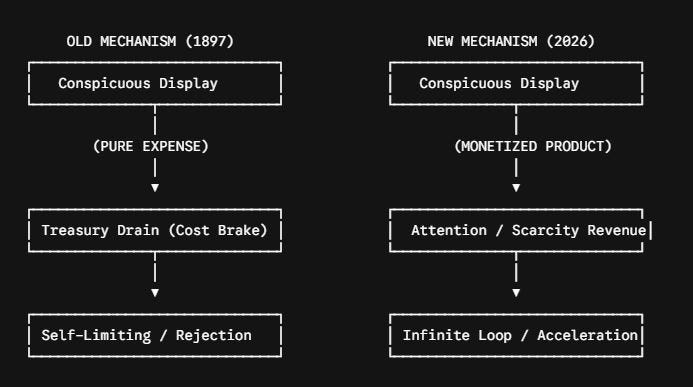
The old mechanism
The economist who diagnosed the first case was Thorstein Veblen, writing in 1899, and his core finding was narrower and colder than “rich people like to show off.” A display of leisure only works if it is witnessed, and it only works as a signal if there is a visible slope beneath it, a rank just above your own, close enough to imitate. Waste, not comfort, is the real currency: spending in a way that is not useful is what proves you are exempt from having to be useful. The Waldorf ball cost a fortune and produced nothing. That was not incidental to the display. It was the entire point.
What Veblen’s model assumed, without needing to say so, was that this kind of display cost the displayer. It drained the treasury of whoever staged it. That cost was the system’s only brake. It is also the piece of the mechanism that has since been removed.

The frontier that got monetized
For a century, the things being commodified were objects, then services, then attention itself. Leisure, the pure performance of not needing to work, was one of the last things that still cost money to display rather than earning it. That is no longer true, and the reversal is the actual discovery here: for most of history, leisure was proof you had escaped economic necessity. In the current economy, performing leisure has become an economic necessity in itself. The image of freedom from work must now be manufactured, on a schedule, to generate income. The Waldorf ball was pure expense. A curated home, filmed and monetized, is income. That single flip, display moving from cost column to revenue column, is what changed everything downstream, because it deleted the only brake the old system had. Nothing drains the treasury of a lifestyle brand for being wasteful. Waste is the product now, and the product pays for itself.

Two machines, one gap
Once display can earn rather than only cost, two distinct businesses form around it, and it matters that they are not the same business, because they hit different people in different ways.
One monetizes scarcity. This is the North Coast model: real capital enforces real exclusion, then charges for the exclusion itself. The fee is not a pricing error. It is the product. Access has to be hard to get or there is nothing to sell.
The other monetizes aspiration. This is the creator-economy model: an image of abundance is manufactured and distributed to an audience that mostly cannot afford the thing pictured, and what is actually being sold is not the lifestyle, it is the audience’s attention, harvested while they watch a life they are told to want. A following in the millions, the overwhelming majority of whom could never buy what is on screen, is not a failed sales funnel. It is the business model working exactly as designed. If most viewers could afford the life shown, it would stop being aspirational, and it would stop selling.
Different tactics, identical exhaust: both extract value from the same person, the one who can see the top and cannot reach it. One sells the wall. The other sells a picture of a ladder that was never actually there.

The imitator’s role
Neither machine runs on supply alone. Veblen’s original model required a second party, the imitator, the person willing to read someone else’s spending as a meaningful signal and measure their own life against it. That requirement has not gone away. It has simply found a much larger population to work with, because a habit that once belonged to a village watching its wealthiest household now belongs to anyone with a feed. The system survives because it recruits its own audience into completing it: buying the affordable version of an unaffordable look, adopting the vocabulary and posture of a life that cannot actually be reached, measuring an ordinary week against a curated, extraordinary one and coming up short. None of this requires believing the display is literally true. It requires only the trained reflex of treating display as meaningful in the first place, a reflex built over more than a century of pricing that taught people to mistake cost for quality and visibility for worth, refined now by an algorithm that repeats the lesson daily, to each viewer individually. The uncomfortable part of the diagnosis is that elites and platforms did not invent this reflex from nothing. They found it already present in the emulation Veblen described, and monetized it. The imitator is not a bystander in this system. The imitator is what closes the circuit: the tower stands because enough people, trained to look up, keep looking.

The indifferent elevator
The aspiration machine has an operator, and it is worth being precise about what kind of operator it is, because the precision changes the diagnosis. A recommendation algorithm does not reward beauty, authenticity, or merit. It rewards engagement, time spent, comments, shares, and it has no mechanism for telling the difference between engagement produced by something genuinely remarkable and engagement produced by something engineered to provoke a reaction. A staged kitchen and a real one register identically if they hold attention equally long. The system was never asking whether the display was true. It was only ever asking whether people looked.
That indifference has a second-order effect that matters more than the first: reach itself starts to read as legitimacy. A video with tens of millions of views feels validated by its own scale, regardless of what produced the scale. The platform does not just fail to filter for authenticity, it launders the question away, because enough visibility manufactures the appearance of having earned it. This is a harder problem than a biased human gatekeeper, who can in principle be persuaded or shamed. An engagement-maximizing system has no such surface to appeal to. It is not corrupt. It simply runs, at scale, regardless of who operates it.

From pyramid to tower
Put the enclosure machine and the algorithmic machine together and the shape of the whole structure changes, not just its size.
A pyramid, whatever its unfairness, is load-bearing: each tier is adjacent to the one below it, and Veblen’s emulation ran on that adjacency, you imitated the rank just above because it was close enough to plausibly reach. The pyramid also told a story, and the story mattered as much as the geometry: climb, and you arrive. That story was always partly fiction, even in 1899. But the fiction did real work. It manufactured consent to an unequal structure by making the inequality feel like a hierarchy in motion rather than a wall.
What monetized leisure builds instead is a tower: the top made maximally visible, continuously, to everyone, while the path to it goes maximally absent. Visibility up, mobility down. And a tower has no staircase, it has an elevator, and someone else operates it. On the North Coast, the elevator is capital and connections: a single transaction or a single phone call moves you in, with nothing resembling the incremental climb a staircase would require. On the feed, the elevator is the algorithm: a person can be unknown on Monday and reach millions by Friday, a velocity no staircase could ever produce. Ascent stops being a function of what you built and becomes a function of who noticed you, a capital allocator, a recommendation system, a brand. Selection replaces effort as the currency of arrival.
That substitution has a behavioral consequence worth naming plainly: it redirects initiative. If ascent runs on being selected rather than on what you produce, the rational response is not to build, it is to become selectable, to optimize for visibility and proximity to whoever is running the elevator. The labor does not vanish. It relocates, from making things to being noticed making things. That is the leisure-becomes-work paradox in its full form: an entire tier of effort now goes into performing exemption from effort, because performing it, convincingly and often, is the only way left up.
This is also why the tower produces imitation rather than evolution, and the distinction is exact, not poetic. Evolution requires variation with no target specified in advance, many different strategies tried, fitness judged only after the fact, novelty sometimes winning simply because the environment shifted underneath it. The tower runs the opposite process. The criteria are published up front: what a feed rewards, what a viral format looks like, what a gatekeeper’s taste already runs on. There is no waiting to be judged after trying something new, there is a known target, and the fastest way up is to converge on it directly. That is closer to training against a fixed loss function than to natural selection: the score is visible, the gradient is visible, and deviation from what already works is simply a worse move. Nobody has to be unoriginal by temperament for a tower to fill up with sameness. Sameness is the correct strategy under those rules. Watch any platform for a week and the convergence is visible in real time, one trending format, one aesthetic, one voice, replicated at scale, not because a generation lost its imagination but because imagination stopped being the variable being scored.

Why this is a stability question, not a taste question
Here is the diagnostic point, and it is the one worth a government’s attention rather than a moralist’s. What actually holds an unequal society together is not the absence of inequality. It is belief in the path, the sense, however imperfect, that position is earned and can be improved. A pyramid can sustain enormous unequal distance for a very long time as long as that belief survives. What it cannot survive is the visible, repeated removal of the path itself, broadcast daily to the people standing at the bottom of a structure with no stairs.
That is the mechanism behind the anger already visible at Marassi, and it should be read as data, not as noise. The lawsuits are the formal channel. The memes, the visa jokes, the DNA jokes, are the informal one, and they are doing real work: converting a material grievance about a fenced shore into a public language of exclusion that spreads faster than any legal filing. It is worth noting, too, that Egypt’s state statistics agency has been withholding fresh poverty figures, which functions, intentionally or not, as its own kind of visibility management. None of this requires a conspiracy to explain. The public record, a coastline sold to foreign capital in a $35 billion deal that helped rescue the currency, then fenced and metered in the harder currency it was sold for, is sufficient on its own.
The signal worth monitoring is not the existence of luxury. It is the ratio between how visible the top of a society has become and how reachable it remains, and whether that ratio is moving toward a tower or back toward a pyramid. A useful proxy, in any market: is the display in question still costing its producer money, or has it started earning? The moment display flips from expense to income, the brake is gone, and the gap becomes something someone is financially motivated to widen rather than close. Track that flip, sector by sector, and the crisis becomes visible in the data well before it becomes visible in the streets.
Cornelia Bradley-Martin’s ball was pure cost, and the backlash it produced still had somewhere to go, into sermons, into newspapers, into a single expensive night that was not repeated at that scale for a generation. The structure monetizing conspicuous leisure today does not carry that same built-in ending, because the anger it produces is not a byproduct anyone is embarrassed by. It is attention, and attention is the fuel that keeps a system like this running rather than the friction that once slowed it down.
Societies have tolerated deep, durable inequality before, for generations at a stretch, without coming apart. The record is clear on that point, and it would be dishonest to pretend otherwise. The harder and more precise question is not whether inequality is tolerable, it plainly can be. It is whether a society can tolerate a version of it in which the symbols of exclusion are becoming more visible, more profitable to produce, and harder to escape, all at once, with no mechanism left inside the system to slow any of the three down. That is not a forecast. It is a description of something already measurable, on a fenced beach and on every feed built the same way, and it is the number worth watching.
None of this requires a verdict on whether watching is right or wrong. Wealth has always displayed itself, and people have always watched; that part of the arrangement is old and is not going anywhere. What is worth asking, and what no policy or platform can answer on anyone’s behalf, is smaller and closer to home: what does a life actually gain from the hours it spends measuring itself against a tower that was built to be watched, edited to be envied, and priced to keep the feed open. Not whether the tower should exist. What it is worth, to the people standing at the bottom of it, to keep looking up.

If this made you feel seen, challenged, or called you’re not alone. Lights On is for those who crave more than noise, trends, and surface takes. Your presence here means something. Subscribe and stay with the signal.

Note:
Author’s Note: Veblen’s Theory of the Leisure Class
In The Theory of the Leisure Class (1899), American economist and sociologist Thorstein Veblen introduced two core concepts that explain how status functions in unequal societies:
Conspicuous Consumption: Spending money on luxury goods or non-essential items to publicly display wealth and social standing.
Conspicuous Leisure: The non-productive consumption of time, engaging in costly, time-consuming activities (such as learning obscure etiquette, hosting elaborate galas, or playing specialized sports) simply to prove one is exempt from the manual labor required to survive.
The Core Veblenian Mechanic:
For Veblen, status signaling relies on waste, waste of money or waste of time. Crucially, in Veblen’s original 19th-century model, this display was a pure financial drain on the displayer. The extravagance was effective precisely because it cost money without generating income, serving as undeniable proof of absolute financial security.
What modern digital architecture has changed is not the human impulse to signal status, but the economic direction of the signal itself: performance leisure has transitioned from an expense that drains capital into a product that generates it.

Related Article :


You have packed tonnes into this. Total admiration of how you continue to deliver synamite post after post
A pyramid had stairs you could at least see, even if they were steep. A tower just has an elevator operated by someone else, and the algorithm decides who gets on. Great post, Farida!