

The Distance Problem: Why Your Best Decisions Happen When You Stop Caring
Most leaders swing between endless analysis and impulsive chaos. Catherine the Great used a third option. Here is how to find it

If this made you pause, you’re not here by accident.
Lights On is for people who choose signal over noise.
Stay.
The Distance Problem
June 28, 1762. Catherine learns her husband plans to arrest her. She has hours to decide.
Get closer, map every ally, every risk, every variable? Or grab the hammer, act now, sort consequences later?
She did neither. She stepped back, saw the one pattern that mattered (the guards regiment was ready to turn), then struck once, precisely. That night she became Empress of Russia.
Most of us aren’t facing coups. But we face the same choice: analyze to paralysis or act to chaos.
There’s a third option.
The Two Tools That Destroy Clarity
Nietzsche warned that people who fight monsters start becoming them, not through violence, but obsession. They get so fixated on the problem they lose the perspective needed to solve it.
He could have been describing how we make decisions.
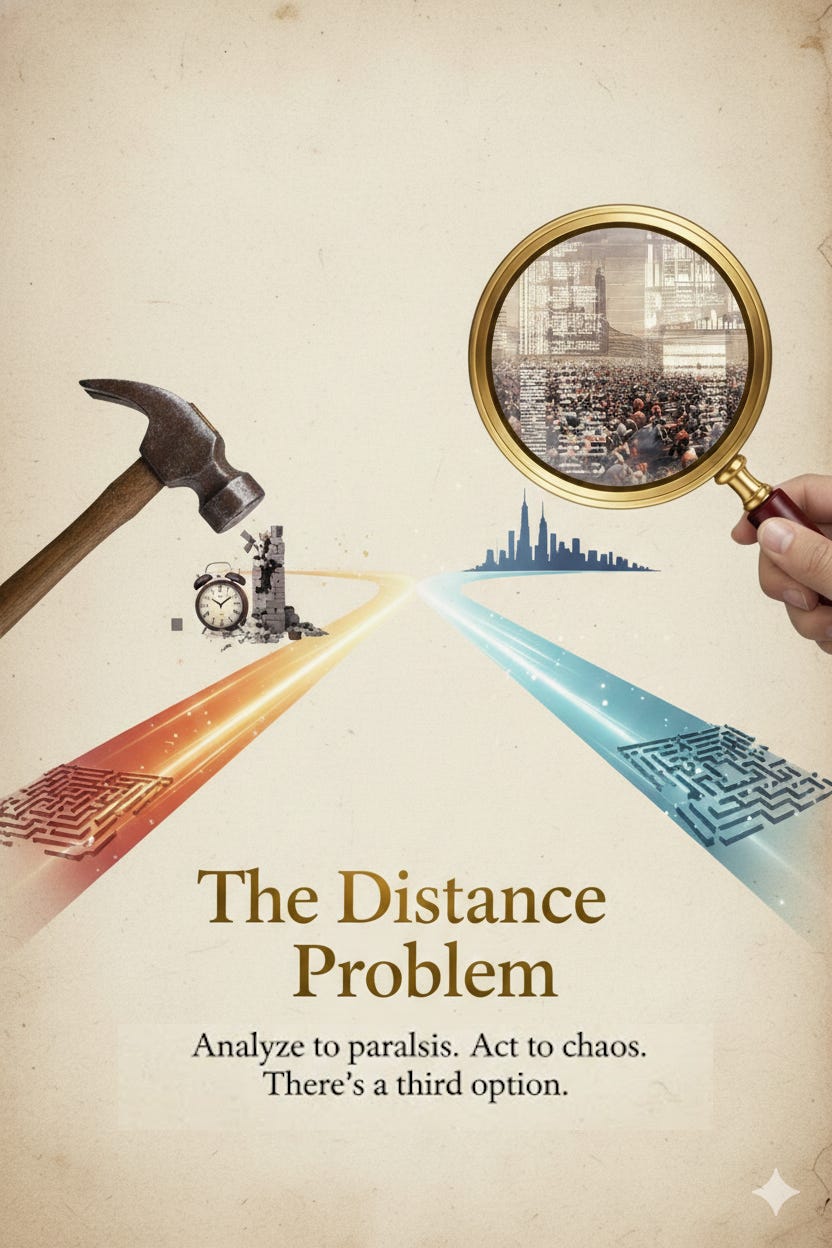
The magnifying glass: Endless analysis. You examine from every angle, collect more data, consult more people. You think you’re being thorough. Actually, you’re losing context.
Stand too close to a painting and you see brushstrokes but miss the image. In business: spending three weeks perfecting a pitch deck while the market closes. Interviewing seventeen candidates searching for perfection. Building financial models that assume precision in an uncertain world.
The hammer: Impulsive action. You hit hard and fast. Make the call, fire the person, launch the product. You think you’re being decisive. Actually, you’re destroying nuance.
When everything’s a nail, you miss the subtlety that might reveal a better path. In business: hiring the first decent candidate because you’re desperate. Cutting costs across the board instead of strategically. Making promises you haven’t thought through.
Both feel productive. The magnifying glass gives you the illusion of progress through information. The hammer gives you the illusion of progress through action.
Here’s the truth both tools hide: Neither is really about distance. Both are about fear. Neither moves you toward clarity.
The Real Question: What State Are You In?
In Brazilian Jiu-Jitsu, there’s no ambiguity. You know instantly whether you’re on offense or defense. You feel it, the pressure, the positioning, your breathing.
Most people in business never ask which state they’re in.
Defense mode: Fighting for survival. Absorbing pressure. Reacting. Your focus must be immediate, generate cash this month, cut costs tomorrow, stabilize fast.
Offense mode: Building for the future. Creating pressure. Dictating what happens next. Your focus expands, develop capability for two years out, invest in things that won’t pay off immediately.
The right distance depends on your state.
When you’re on defense, get closer, you need tactical clarity and speed. But not so close you panic and make decisions that mortgage the future.
When you’re on offense, step back, you need strategic clarity and pattern recognition. But not so far you miss the real constraints and waste resources on abstractions.
Most bad decisions come from operating in the wrong mode. Defense mindset while on offense: you under-invest in growth because you’re still traumatized from the last crisis. Offense decisions while on defense: you burn runway on “strategic” hires while missing payroll.
In a cockpit emergency, pilots are taught: “Fly the plane first.” Not “fix the blinking light.” Step back to see what will actually kill you.
Most business advice gets this backwards.
When you’re in survival mode (missing payroll, losing key customers, runway ending), your instinct says “get closer, fix everything.” That’s how you create tunnel vision. You obsess over seventeen problems when only two will kill you.
On defense, step back. See the whole board. Ask: “What are the 2-3 things that will actually end us?” Ignore everything else. Then move fast on those specific things.
On offense, step back differently. You’re not looking for threats, you’re looking for patterns. Where’s the leverage? What compounds over time? Then get close enough to validate before committing.
Catherine didn’t analyze the coup to death. She didn’t rush blindly either. She stepped back, saw the single hinge point, verified it (rode to the regiment herself), then acted.
The Practice (60 Seconds)
Before any decision that matters, ask:
1. What am I actually afraid of?
Being wrong? Looking foolish? Wasting resources? Name it. If you can’t name it, you can’t work with it.
2. What state am I in?
Defense (something will break if I don’t act) or offense (building for later)?
Defense = ruthlessly simplify to 2-3 things that matter
Offense = step back to see patterns, get close to validate
3. Am I using my tool as a crutch?
Magnifying glass: collecting information or avoiding commitment?
Hammer: being decisive or outrunning thought?
4. What would right distance see?
Close enough to understand the constraints
Far enough to see the pattern
Both, not either/or
Set a tripwire: “I decide by Friday” or “I’ll write three ways this fails before committing.”
Then decide. Not perfectly. But clearly.
What This Actually Is
The distance problem isn’t about decision-making. It’s about your relationship with uncertainty. Some zoom in when uncertain because detail feels like control. Some strike when uncertain because action feels like progress.
Both are escaping the discomfort of not knowing.
The right distance doesn’t eliminate uncertainty. It lets you act effectively despite it.
When you catch yourself reaching for magnifying glass or hammer, the real question isn’t “What should I do about this decision?”
It’s “What am I trying to escape by getting too close or moving too fast?”
Usually: the feeling you might be wrong. The fear you don’t know enough. The discomfort of not being certain. Once you see that, you can make a different choice. Not to eliminate discomfort, but to not let it choose your distance.
Catherine didn’t wait for certainty. She found the one thing worth betting on and moved.
You probably already know what that is for you.
The question is whether you’ll let fear choose your distance, or whether you will.
Where You Are Now
If you recognize yourself in the magnifying glass: You’re already thinking about researching “optimal decision frameworks.” Stop. Pick one current decision. Ask the distance questions. Decide by Friday.
If you recognize yourself in the hammer: You’re ready to implement this across your entire team tomorrow. Slow down. Pick one current decision. Force yourself to articulate three ways it could fail before acting.
You already know what you need to know. The question is whether you can apply it at the right distance.
The only way to find out is to try.
Relevant Articles 👇🏼


Another winner!! As I read this, I couldn't help but wonder about Silicon Valley's mantras of "move fast and break things" and "you're going to fail, fail early". Jazz musicians have a saying: "If you make a mistake in a solo, make it at least twice. Then, it's not a mistake, it's cool and innovative."
Great article Farida
Let me add something from my own experience.
Sometimes stepping back to gain clarity can also backfire. It can be a response to a threat, just one that hides behind intellectual distance. The tension stays. The expectations, too.
When it actually works, the step back comes from confidence instead.
An honest recognition of the anxiety, a clear view of the fear, and of the bias shaping it.
From that place, leaving the situation creates space.
And in that space, a spontaneous thought often appears, offering a new perspective.