

The Cost of Missing Context
Why smart leaders break things and how to stop repeating the same mistakes

If this made you pause, you’re not here by accident.
Lights On is for people who choose signal over noise.
Stay.
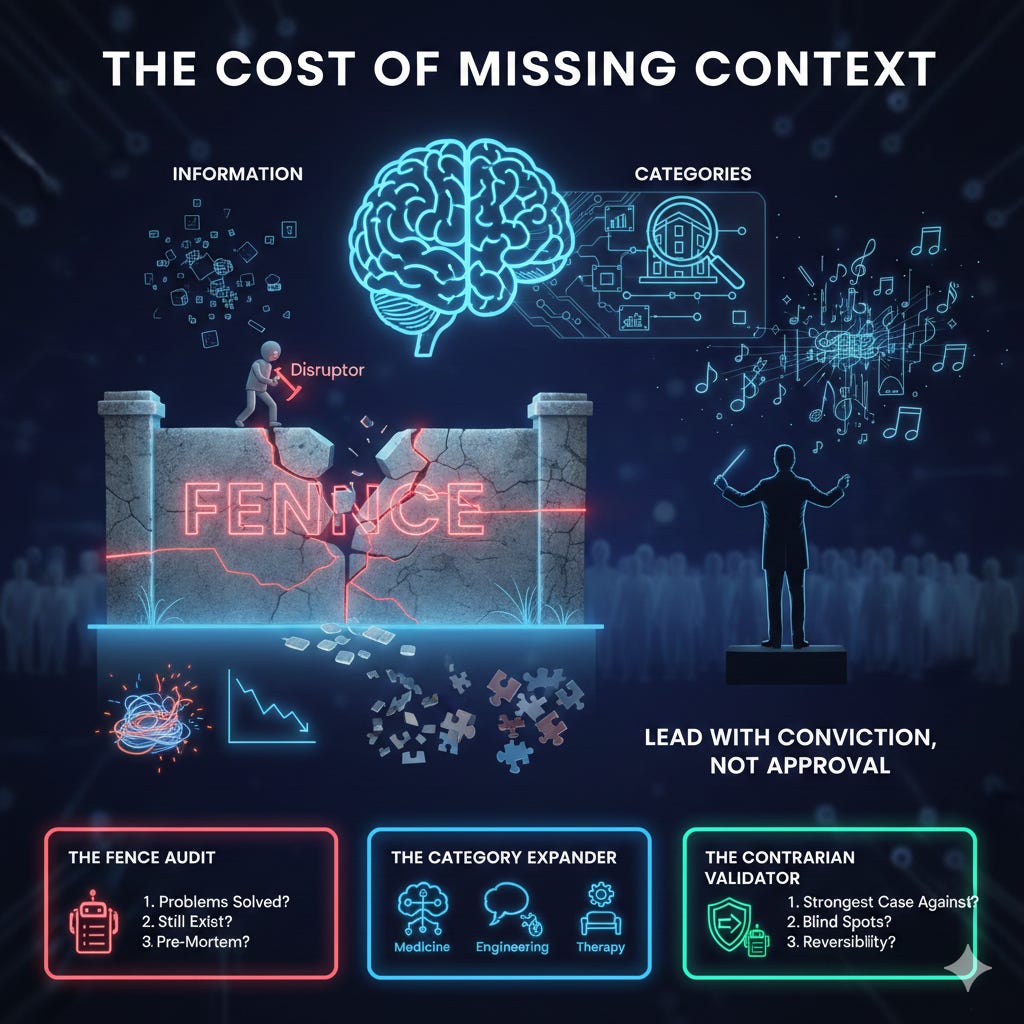
A tech founder I know once eliminated mandatory code reviews at his startup. They seemed slow, bureaucratic, a relic from his previous corporate job. “We’re a fast-moving startup,” he announced. “We trust our engineers.”
Three months later, a junior developer pushed code that corrupted the production database. Thousands of customer records scrambled. The bug took four days to fix because no one else had reviewed the logic before it shipped.
Turns out, code reviews weren’t about distrust. They were about catching what one person, working alone at 11 PM, inevitably misses. The founder had torn down a fence without understanding why it was built.
He learned what Peter Drucker warned decades ago: “Don’t fix what isn’t broken until you understand why it works.”
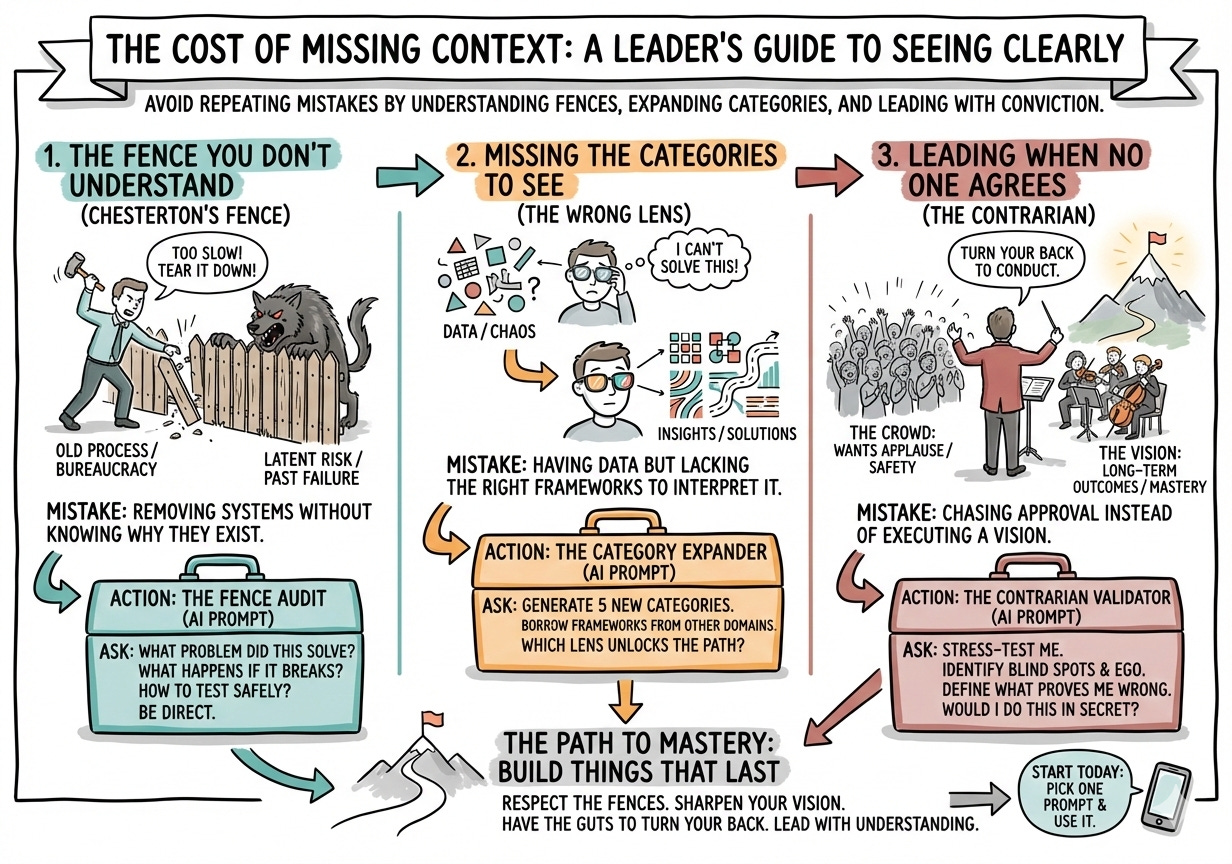
The Fence You Don’t Understand
Every organization, every team, every system is full of fences, processes that seem outdated, meetings that feel pointless, rules that appear arbitrary. The modern instinct, especially in a world that worships speed and disruption, is to tear them down.
“This approval process takes too long, kill it.”
“This weekly sync is a waste of time, cancel it.”
“This documentation requirement is bureaucratic, ignore it.”
Sometimes that’s right. Often it’s not.
Because here’s what most people miss: structures, even inefficient ones, exist to solve real problems. A fence was built because something, a failure, a crisis, a painful lesson, made someone say “never again.”
The question isn’t whether the fence looks stupid. The question is: do you know what happens when you take it down?
Why We Keep Making the Same Mistakes
I see this pattern everywhere:
New leaders arrive at companies, see “legacy processes,” and gut them to prove they’re agents of change. Six months later, they’re quietly rebuilding the same systems under different names because the original problems resurface.
Founders abandon strategies that feel slow because a competitor is moving faster. They pivot, chase trends, try to out-execute everyone, only to discover their original approach was working, just on a timeline longer than their patience.
Teams replace “old tools” with new ones, migrating data, retraining everyone, disrupting workflows—then realize the old system was designed around constraints the new tool doesn’t account for. The migration becomes permanent chaos.
This isn’t about resisting change. It’s about understanding that innovation without context is just expensive repetition.
The most dangerous person in any organization isn’t the one who resists change, it’s the one who changes things confidently without asking why they exist in the first place.
What You’re Actually Missing
Here’s where it gets deeper.
Sometimes the problem isn’t that you’re missing information. It’s that you’re missing the categories to interpret what you’re seeing.
The information hadn’t changed. The ability to interpret it had.
This is the problem most people don’t realize they have. You can’t solve what you can’t see. And you can’t see what you don’t have categories for.
In business, it shows up everywhere:
You see a team member struggling and think “they’re underperforming.” But is it a skill gap, a motivation issue, a role misalignment, or a lack of resources? The category you choose determines the solution.
You see revenue declining and think “we need better marketing.” But is it a demand problem, a product problem, a pricing problem, or a positioning problem? Pick the wrong lens and you’ll optimize the wrong thing.
You see conflict on your team and think “personality clash.” But is it unclear expectations, misaligned incentives, poor communication norms, or unresolved past resentments? The frame determines whether you mediate, restructure, or ignore it.
The quality of your categories determines the quality of your decisions.
Entrepreneurs who spot opportunities everywhere aren’t luckier or smarter, they have better lenses. Leaders who move decisively aren’t just confident, they’ve organized the chaos into frameworks that reveal what matters.
You don’t need more data. You need better ways to see what the data means.
Leading When No One Agrees With You
Understanding context matters. Having clear categories matters. But there’s a third piece that makes leadership brutally hard:
Sometimes you have to turn your back on the crowd.
Islwyn Jenkins said it perfectly: “A man who wants to conduct the orchestra must turn his back to the crowd.”
The crowd wants applause. They want visible progress. They want you to do what feels safe, what everyone agrees on, what won’t embarrass anyone if it fails.
But leadership isn’t about satisfying expectations. It’s about executing a vision even when no one else sees it yet.
I’ve lived this. We once turned down a partnership that would have brought immediate revenue, fast. Everyone around us thought we were crazy. “It’s free money,” they said. “Why are you overthinking this?”
But we saw what they didn’t: the partnership would have locked us into serving a market segment we deliberately avoided, one that would demand features that contradicted our core product vision. Taking that money meant becoming a different company. Six months later, that market segment collapsed. The “obvious opportunity” would have killed us, slowly, by pulling us away from what actually mattered.
In the moment, all anyone saw was us leaving money on the table. But we weren’t ignoring feedback, we were operating from context and categories the crowd didn’t have. We knew why certain fences existed. We could see patterns they couldn’t. And we were willing to be misunderstood in the short term for outcomes that mattered in the long term.
Turning your back to the crowd isn’t arrogance. It’s discipline.
If you let applause guide you, you’re no longer leading. You’re performing. And performers don’t build anything that lasts, they just give people what they already expect.
The Prompts That Make This Real
Philosophy is useless if you can’t apply it. So here’s how to use this tomorrow:
When You’re About to Kill a Process (The Fence Audit)
Before removing or changing any system, paste this into an AI:
Prompt:
I’m considering removing this process: [DESCRIBE IT]
Help me understand if I should:
1. What problems might this have been designed to solve? (List 3-5 possibilities)
2. Which of those problems still exist today?
3. Run a pre-mortem: If I remove this and something breaks in 6 months, what are the 3 most likely failures?
4. How can I test this safely with one team for 30 days before rolling it out?
5. If I remove it, what replaces it or why is replacement unnecessary?
Be direct. Tell me if I’m about to make a mistake.
Use this before the next meeting where someone says “let’s just kill this thing.”
One founder used this and discovered their “pointless” weekly all-hands was the only time remote employees felt connected to leadership. Killing it would have destroyed culture invisibly and he would have blamed it on “remote work problems” six months later.
When You’re Stuck on a Problem (The Category Expander)
When you keep hitting the same wall, paste this:
Prompt:
I’m stuck on this problem: [DESCRIBE IT]
I keep seeing it as [YOUR CURRENT FRAME], but I suspect I’m missing other angles.
Help me reframe:
1. Generate 5 different categories for what type of problem this is
2. For each, tell me: What would I do differently? What evidence confirms/denies this lens? What solution becomes visible?
3. Borrow 3 frameworks from other domains (medicine, engineering, therapy) and show me how each would categorize this
4. Which single lens opens the most actionable path forward?
Challenge my current thinking. Show me what I’m not seeing.
One of those lenses will unlock the answer you’ve been missing.
A manager used this on a “toxic employee” problem and realized it wasn’t toxicity, it was someone with deep expertise being ignored in decisions, so they’d become defensive and dismissive. Reframing it as “underutilized expert” instead of “difficult person” changed everything.
When You’re Going Against Consensus (The Contrarian Validator)
Before making a decision everyone disagrees with, run this Prompt :
I want to do this: [YOUR DECISION]
Everyone else thinks: [THE CONSENSUS]
Why I think I’m right: [YOUR REASONING]
Stress-test me:
1. Make the strongest case for why I’m wrong—better than my critics would
2. Identify my blind spots: ego? sunk cost? arrogance vs. real insight?
3. Define what would prove me wrong, with specific metrics and dates
4. How hard is this to reverse if I’m wrong? What’s the cost to others?
5. Would I still do this if no one ever knew I was right?
6. Should I proceed, modify, or abandon this?
Be brutal. Save me from myself if I’m being stupid.
Let the AI challenge you harder than your team can. It has no political risk in telling you the truth.
A CEO used this before ignoring board advice to pivot. The AI identified she was operating on sunk cost fallacy, not genuine insight. She adjusted her strategy, kept the board’s trust, and avoided a disastrous pivot she would have defended out of ego.
What This Actually Means
Leadership isn’t about having all the answers. It’s about asking better questions, seeing patterns others miss, and having the courage to act on what you see even when it’s lonely.
Understand before you change. Don’t dismantle systems without knowing their purpose. The fence might be the only thing preventing disaster.
Organize to see clearly. Better categories reveal solutions that raw information cannot. You don’t need more data, you need better lenses.
Lead with conviction, not approval. Sometimes the right move looks wrong to everyone watching. Do it anyway, if you’ve done the work to know why.
The cost of ignoring context is repeating old mistakes under new names.
The cost of missing categories is solving the wrong problems with confidence.
The cost of chasing applause is conducting nothing, just performing for a crowd that will forget you tomorrow.
The reward for understanding, structuring, and leading wisely?
You build things that last. You solve problems that matter. And you become the kind of leader people follow not because you’re loud, but because you see what they don’t, and you’re willing to act on it.
That’s not just leadership. That’s mastery.
And mastery, whether in business or martial arts or orchestrating change, is about respecting the fences, sharpening your vision, and having the guts to turn your back when the crowd is wrong.
Start with one:
Pick the prompt that matches your biggest current challenge. Use it today. See what becomes visible that you couldn’t see before.
The difference between leaders who thrive and leaders who churn is often just this: the willingness to understand before acting, to see before deciding, and to lead even when it’s uncomfortable.
You already have the information. Now you have the tools to actually use it.
Related Article 👇🏼
This is absolutely essential reading Farida! I spent time over the weekend creating a context vault with Claude so that now every single project that it opens up basically knows exactly what I want in terms of my long-term, medium-term, and short-term thinking. It took four or five hours, but I think in the long term it's going to save me weeks and weeks of time. Hopefully, other creators and founders can adopt a similar approach as well.
I truly value context in a way that I’ve found hard to explain. My ClinftonStrengths finder’s reminder:
You are often fascinated by history and the lessons it reveals, but others may find this information boring or overwhelming. Keep this in mind as you share your perspectives, and look for signs that you’ve lost people’s attention or interest.
Thank you for showing us why this matters and reminding me that it’s an important part of the conversation - even if I might lose people’s attention or interest lol