

The MAAS Collapse: Alcohol Just Lost the War for Your Attention
Two predatory industries fought over the architecture of human connection. One now sits on $22 billion in unsold inventory. The other is collecting the territory. You are the battlefield.

If this made you feel seen, challenged, or called you’re not alone. Lights On is for those who crave more than noise, trends, and surface takes. Your presence here means something. Subscribe and stay with the signal.
Entropy, in Perfect Performance
For decades, one industry held the patent on human connection.
Not through force. Through infrastructure. Alcohol didn’t sell a product, it purchased the architecture of socialization itself. The business meeting sealed over drinks. The first date measured in wine glasses. The promotion celebrated in rounds. The grief processed at a bar. Every ritual of belonging, professional, romantic, communal ran through a bottle. The industry didn’t invent the human need to connect. It simply made itself the toll road.
By the mid-20th century, alcohol had embedded itself into the grammar of social life so thoroughly that abstaining required an explanation. The glass wasn’t a choice. It was the price of admission.
The industry knew exactly what it was selling and what it wasn’t.
Psychologists Claude Steele and Robert Josephs established what Malcolm Gladwell later made widely known in Talking to Strangers: alcohol is not an agent of disinhibition. It is an agent of myopia. It narrows your emotional and mental field of vision, crowds out long-term judgment, and amplifies whatever is immediately in front of you. It doesn’t unlock your authentic self. It temporarily replaces it.
Society already knew this and encoded the knowledge into law. Pilots cannot fly within hours of a drink. Surgeons cannot operate under its influence. Soldiers are prohibited from carrying weapons while consuming it. Drivers face criminal liability past a measurable threshold. Every professional code governing high-stakes human judgment treats alcohol as a cognitive hazard. The same substance was simultaneously marketed as the infrastructure of professional life, the deal sealed over scotch, the network built at the bar, the negotiation smoothed with wine.
Both could not be true. The industry knew which one was. And it built an empire anyway on debt, on suppressed science, and on the manufactured premise that human connection required a glass in hand.
Then a competitor arrived. And it wanted the same thing.
Online platforms didn’t set out to destroy the alcohol industry. They set out to commodify the same human hunger, belonging, intimacy, entertainment, community and they did it more efficiently. A gaming guild builds loyalty without a bar tab. A Discord server runs a community without a cover charge. Dating apps replaced the cocktail bar as the infrastructure of romantic possibility. The platforms didn’t attack alcohol. They simply offered cheaper access to the same need alcohol had monopolized for decades.
The market responded the way markets do.
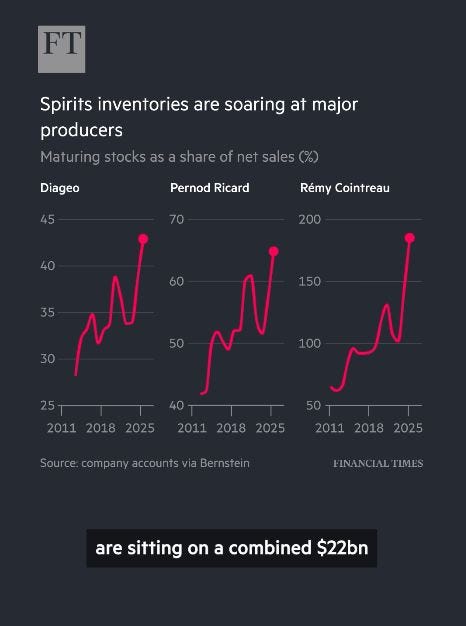
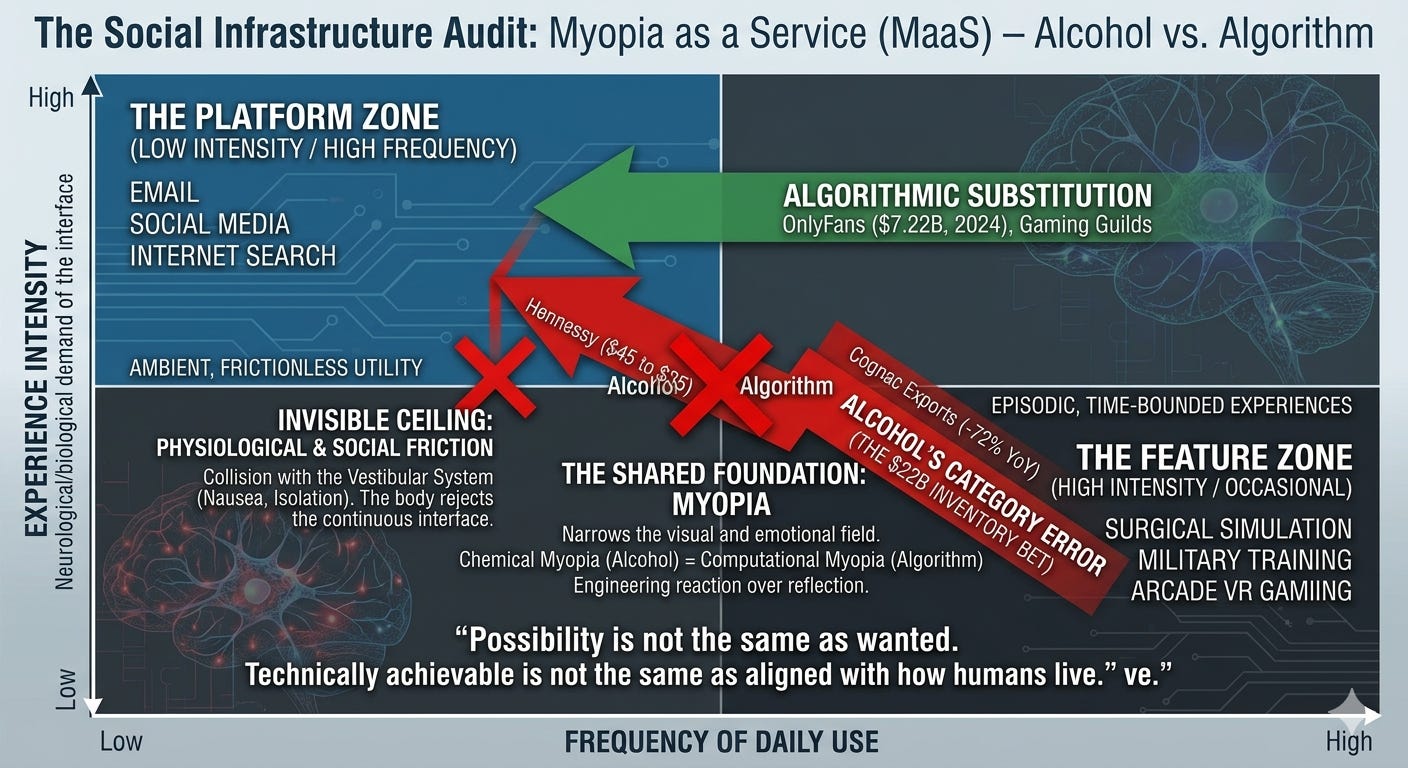
Five major spirits producers, Diageo, Pernod Ricard, Rémy Cointreau, Campari, and Brown Forman are now sitting on a combined $22 billion in unsold inventory, the highest level in over a decade. Rémy Cointreau’s maturing stock has reached approximately 185% of its annual revenues, close to its entire market capitalization. Hennessy, which commanded $45 a bottle during the pandemic, has been cut to $35. Cognac exports fell 72% year on year.
But the inventory figure alone understates the damage. Pernod Ricard is carrying €11.168 billion in net debt, with a leverage ratio of 3.8x, and the unsold stock is actively worsening that position. Diageo issued $1.5 billion in new bonds in 2025, borrowing fresh capital while sitting on mountains of product it cannot move. This is not a glut. It is the receipt of a debt-financed bet on human behavior, a bet that the need to socialize was permanent, that the glass was irreplaceable, and that prices could keep rising without consequence.
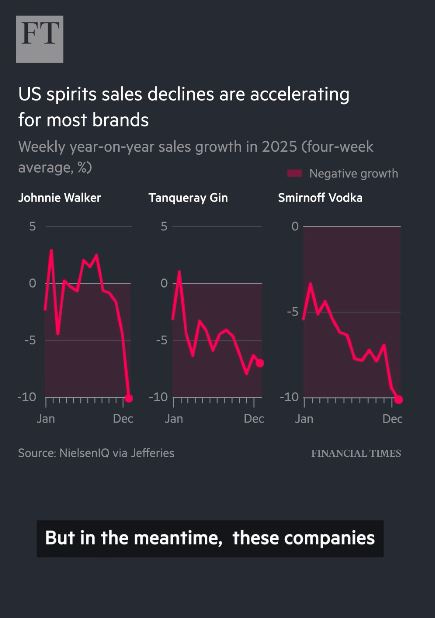
Johnnie Walker, Smirnoff, and Tanqueray each declined roughly 10% in weekly US sales through 2025. This is not a supply chain problem. It is a demand verdict.
The money didn’t disappear. It redirected. Consumers spent $7.22 billion on OnlyFans alone in 2024. Gaming subscriptions, dating apps, and streaming platforms now absorb what bars once collected, but the average cocktail in a major US city runs $19 to $22 before tax, tip, and the cost of getting home. A monthly platform subscription costs less than a single round. The substitution wasn’t ideological. It was arithmetic.
Our cheers became emojis. Our rounds became subscriptions. The bar tab became a screen time report. And the industry that built its empire on being the only place connection happened found itself holding billions in borrowed money and unsold stock, staring at a generation that had found another way in.
Here is where the story should end cleanly, health awareness defeats a harmful industry, and the better side wins.
It doesn’t end there.
MAAS: Myopia as a Service
The platforms running the same commodification operation are also running the same suppression operation. Meta’s own internal research surfaced by whistleblower Frances Haugen in 2021, showed the company knew Instagram was worsening body image issues in teenage girls and chose growth over intervention. The algorithm is engineered for engagement, not wellbeing.
The mechanism is structurally identical to alcohol’s. Alcohol creates myopia by chemically narrowing the field of vision to the immediate. The algorithm creates myopia by design, optimizing for the most triggering content, crowding out context and long-term consideration, rewarding reaction over reflection. Chemical myopia. Computational myopia. The same architecture on different hardware.
Screen addiction research accumulating in the literature faces the same institutional friction that alcohol and cancer research faced thirty years ago. The correlation between heavy platform use and depression, anxiety, and loneliness is consistent, and it is treated accordingly, quietly.
The usurper and the incumbent are the same company in different clothing.
Nobody planned this outcome.
No health campaign toppled the alcohol industry. No regulation succeeded where decades of lobbying had neutralized everything. A competitor simply wanted the same market share and took it. One predatory industry disrupted another, and the collision produced, by accident, a health dividend nobody designed.
Spirits sales are falling. The non-alcoholic category grew 27% in 2024. The Lancet’s finding, no safe level of alcohol consumption is finally reaching people who hadn’t heard it, not because the industry stopped suppressing it, but because their monopoly on social infrastructure crumbled under the weight of its own debt.
This is entropy in perfect performance. A system producing an outcome no rational actor would have engineered intentionally.
We did not defeat alcohol. Two industries fought over the same wallet, the same evening, the same human need for connection and one lost. We are the territory they were fighting over. And for once, being the territory had a benefit.
The mental health bill from the winner is still arriving. That bill will come due.
But today, the glut is real. The warehouses are full. The prices are falling.
They say two wrongs don’t make a right.
This time, they did.
Note on Multivariate Entropy: While this audit focuses on the structural migration from chemical to computational myopia, the $22 billion inventory glut is a product of a wider "Perfect Storm." The arrival of GLP-1 medications (which suppress the physiological craving for alcohol) has combined with the "Instagram Aesthetic" (the high-velocity social pressure for physical optimization) to create a biological pincer movement against the spirits industry. When you add Macro-Inflation to this mix, the "Price of Admission" for a night out didn't just become culturally expensive, it became biologically and mathematically irrational.
Sources: Financial Times, “Why drinks makers are slashing prices” — Madeline Speed (2025) | NielsenIQ via Jefferies (2025) | Pernod Ricard H1 FY2025 Financial Results | Diageo FY2025 interim report | OnlyFans Financial Summary (2024) | Gladwell, Malcolm. Talking to Strangers (2019) | Frances Haugen congressional testimony (2021) | The Lancet, “Alcohol use and burden for 195 countries” (2018)
In the US, HHS suppressed a landmark study showing a link between ANY alcohol consumption and cancer that was scheduled for release last September, I think. Clearly they did so at the behest of a failing liquor industry.
The US liquor industry was hit especially hard in 2025 when Canadians en masse boycotted American made spirits, which crippled those companies. This was a direct result of the government's strong anti-Canadian-sovreignty rhetoric.
So there was a lot of push and pull yet despite the damaging report not being released, those other market influences were simply too strong.
I believe that the study primarily affirmed that there is no safe level of alcohol consumption. Anecdotally, I take GLP1 medication and I haven't had a drink in almost 2 years, well after starting it. I was a casual drinker and I've also found that I don't miss it at all. I haven't looked back.
The spirits manufacturers/distillers are in grave trouble and they know it