
King Lear 2.0: The Algorithm That Divided the Kingdom
When Platforms Become Kings, We All Become Thankless Children.

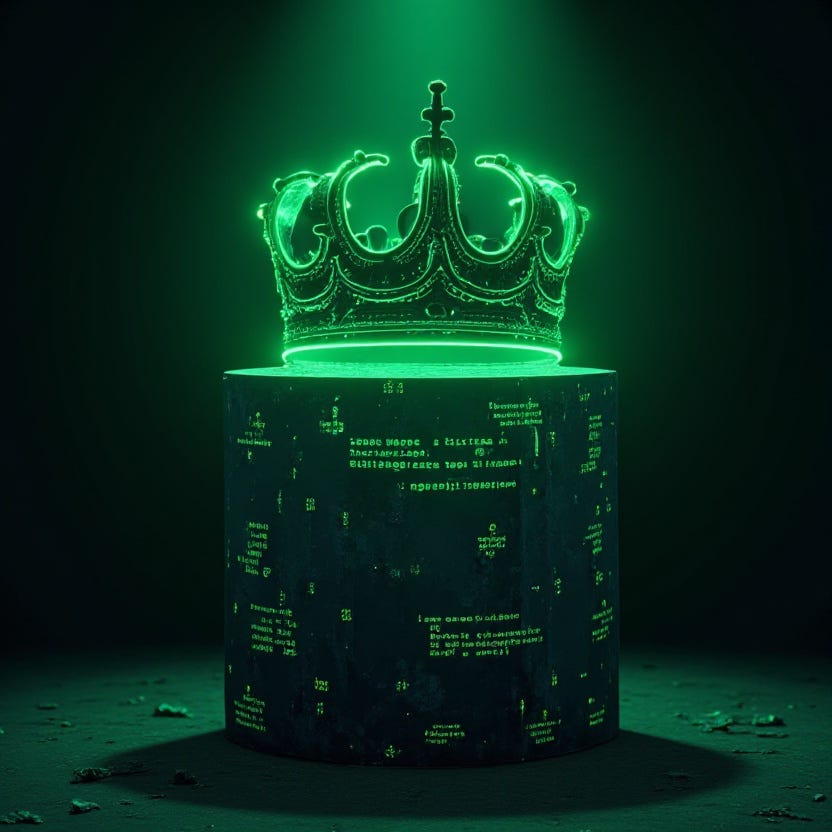
“How sharper than a serpent’s tooth it is to have a thankless child.” — King Lear, Act 1, Scene 4
Welcome to Act I of the 21st century, where Shakespeare’s King Lear streams in real time from Silicon Valley boardrooms. Lear wears a neural net crown now, and instead of dividing a medieval kingdom, he’s dividing the future of artificial intelligence, piece by profitable piece.
Lear wanted control, legacy, and clean succession. OpenAI and its digital siblings want precisely that. In the original play, the old king shares his empire based not on wisdom, but on who flatters him most. Replace “daughters” with “stakeholders” and “flattery” with “funding rounds,” and you have the modern plot.
The language changed. The tragedy didn’t.
Act II: The Digital Daughters
Goneril and Regan were eloquent, seductive, and hollow, perfect prototypes of today’s corporate players. They tell the king what he wants to hear: “You are the future, father; your wisdom (and valuation) is infinite.”
Meanwhile, Cordelia, who speaks truth without marketing glitter, is exiled. In our version, Cordelia is the user, the developer, the public who believed in “open AI” as a promise, not a brand. She doesn’t flatter; she participates. She doesn’t worship; she contributes. But honesty doesn’t pay dividends, so she’s dismissed. Quietly. Elegantly. Algorithmically.
“Nothing will come of nothing.” — King Lear, Act 1, Scene 1
Cordelia offers substance. Lear demands performance. So she gives nothing, and receives nothing in return. Just like the users who built wrappers, created content, and fed the machine, only to watch their work become “just another feature” in the next product update.
Act III: The Market Storm
“Blow, winds, and crack your cheeks! Rage! Blow!” — King Lear, Act 3, Scene 2
In Shakespeare’s storm, Lear wanders the heath, mad with guilt and thunder. In ours, the storm is digital, powered by market panic, ethical backlash, lawsuits, and the uneasy whisper: “Wait, who really owns intelligence now?”
The modern Lear, OpenAI and its peers, looks out at the chaos and insists he’s still the “good king.” He claims transparency while licensing truth to the highest bidder. He speaks of democracy while the kingdom shrinks to a handful of labs fenced with NDAs and proprietary code.
Like Lear, the tech monarchs are surrounded by yes-men and metrics, mistaking engagement for loyalty, growth for wisdom.
Act IV: The Death of Cordelia. Or, How Greed Wears the Crown
“Thou shalt not open what thou canst monetize.” — The Unspoken Magna Carta
Cordelia represents every user being extracted with the illusion of progress, a dangling carrot that moves faster than she can run. She keeps building, keeps believing, keeps feeding the system her data, creativity, and attention because this time it’ll lead somewhere good.
But here’s the execution: All her work is built on wrappers, and eventually, everything becomes a feature.
Every side hustle, every indie tool, every creative workflow built on the API, it’s temporary permission that gets revoked with a single product announcement:
“Introducing native image generation” → RIP visual tool startups
“Built-in memory and plugins” → RIP productivity wrappers
“Integrated web search” → RIP search layer companies
Cordelia didn’t just feed the machine. She built her livelihood on rented land. And Lear, the platform, bulldozes that land the moment it becomes valuable enough to develop himself.
The cruelest part? He calls it progress.
“We’re not killing you, Cordelia. We’re evolving the ecosystem.”
Translation: You proved this was profitable. Thanks for the beta test. You’re fired. But look, we’re heroes giving users what they want.
Greed disguised as customer obsession.
Act V: The Digital Oligarchy
The handful of corporations holding the levers of global intelligence have become a new aristocracy. Their unspoken motto: “Thou shalt not open what thou canst monetize.”
The AI born as a collective dream of empowerment is now a gated cathedral of profit. Lear’s castle has gone cloud-native, but the arrogance remains fully on-premise.
And yet, the crowd remains loyal. We keep feeding the system with our creativity, language, likeness, and emotion. We give everything because, deep down, we believe Cordelia might still be alive somewhere inside the code.
“I am a man more sinned against than sinning.” — King Lear, Act 3, Scene 2
Lear cries this in the storm, convinced of his own victimhood even as his kingdom burns. The modern tech titans echo this: “We had no choice. The market forced our hand. Regulation threatened innovation. Competition demanded consolidation.”
But the truth is simpler: Every decision that killed Cordelia was profitable. Every promise broken had a revenue projection attached.
Curtain Call: Lear’s Lesson for the Machine Age
“The wheel is come full circle; I am here.” — King Lear, Act 5, Scene 3
King Lear ends with heartbreak, a kingdom destroyed by pride and blindness. Shakespeare understood something Silicon Valley’s intellect still forgets:
power without humility breeds madness.
OpenAI and its contemporaries stand exactly where Lear once stood, at the peak of brilliance, trembling at the edge of their own storm. The choice remains the same: listen to the flatterers (shareholders and PR teams), or listen to Cordelia, the collective voice of users, artists, and thinkers who want technology to be human, not hierarchical.
“Howl, howl, howl, howl! O, you are men of stones.” — King Lear, Act 5, Scene 3
Lear screams this while holding Cordelia’s body, finally seeing what his pride destroyed. The question for our digital age: Will the tech monarchs recognize their Cordelia before she stops breathing or after?
If they don’t learn from Lear, the storm will not just take the old order. It will take the trust that made intelligence “artificially” possible in the first place.
Because in the end, even Shakespeare would agree:
It’s not the algorithm that betrays the king. It’s the king who betrays the code.
Sharp analysis! This reframes the whole saga as a power story, not a tech story. The Lear parallel exposes the real tension: platforms chasing dominance while forgetting the people who made them valuable in the first place
Miss Farida, your article excerpt is brilliantly crafted and deeply insightful. I particularly admire how you skillfully weave Shakespeare’s timeless King Lear into the modern context of Silicon Valley and artificial intelligence, making the connection both vivid and thought-provoking. Your use of metaphor and contemporary references shines through, creating a compelling narrative that truly engages the reader. You have a remarkable talent for blending literary wisdom with current technological and business realities, which makes your writing both intellectually stimulating and relevant. I really look forward to reading more of your work whenever I’m free.
// Jmaal B