

Kimi Open-Weight AI: The What and the How
How Kimi K2.6 Brought Swarm-Scale AI Agents Within Reach of Teams That Could Never Have Built Them


TL;DR: Kimi is an open-weight AI model from Moonshot AI that brings frontier-level autonomous AI agents within reach of smaller teams. Instead of simply generating text, it can plan, use tools, coordinate hundreds of sub-agents, and complete long-running workflows. This article explains how Kimi achieves that through Mixture-of-Experts (MoE), Multi-Head Latent Attention (MLA), MuonClip training, and native INT4 inference, and why it marks a major step toward affordable, enterprise-grade AI agents.
The Frontier Went Open
How Kimi Brought Swarm-Scale AI Agents Within Reach of Teams That Could Never Have Built Them

The Frontier Went Open
How Kimi Brought Swarm-Scale AI Agents Within Reach of Teams That Could Never Have Built Them
Give Kimi K2.6 a single instruction and it can break the work into pieces, spin up as many as three hundred sub-agents to handle them in parallel, coordinate roughly four thousand steps across the swarm, and return, in one autonomous run, without a human in the loop, a finished set of documents, websites, and spreadsheets. A year ago that sentence would have described a flagship demo from one of the best-funded closed labs on earth. Today it describes a model whose weights sit on Hugging Face under an MIT license, free for anyone to download, run, and resell.
This is the third piece in a series about the Chinese open models, and it is the one about the capability that was supposed to stay expensive. The first piece argued that DeepSeek collapsed the cost of intelligence. [Deepseek: The New Frontier Is the Invoice.] The second argued that Z.ai’s GLM-5.2 proved the cost fell without the quality falling with it. [GLM5.2: Cheap Was the Easy Part.] Both of those are about a model that answers. This one is about a model that acts, that holds a goal across hundreds of steps, calls tools, recovers from its own mistakes, and does not lose the thread. Long-horizon autonomy is the hardest thing in the field to build and the most expensive to run, which is exactly why it was the last moat. Kimi crossed it in the open. How it did, and what that actually puts within reach, turns out to be narrower and more interesting than the slogans suggest.

Part One: Why Agency Is the Expensive Frontier
A chatbot and an agent are not the same kind of thing, and the difference is mostly a matter of how badly small failures compound.
When a model answers a single question, an error is contained, the answer is slightly worse and the interaction ends. When a model acts over a long horizon, reading a codebase, writing changes, running tests, reading the failures, writing fixes, every step inherits the state of the step before it. An error in step twelve poisons step thirteen, and by step two hundred the model is confidently building on a foundation that quietly broke a hundred steps earlier. This is the failure mode that separates a demo from a tool: not that the model cannot do the task, but that it cannot stay coherent long enough to finish it.
Holding that coherence is expensive in every dimension at once. It requires a context window large enough to keep the entire working history in view. It requires the model to call external tools, read what they return, and fold the results back into its reasoning without drifting. And it requires doing this not five or ten times but hundreds of times in sequence, with the latency and cost of every call stacking on the last. For most of the field’s history, reliable long-horizon agency was therefore something only the best-funded closed labs delivered, because only they could afford to run it. It was the capability you could not get cheap and could not get open.
Kimi’s claim is that this is no longer true. Its thinking variant is built to hold stable tool use across two to three hundred sequential calls without losing the thread; its agentic variants scale that into coordinated swarms. The notable thing is not that it works. It is that it works at a price and under a license that put it in the hands of people who were never supposed to have it.

Part Two: How It Got There
Swarm-scale agency from an open model is not a single trick. It is a stack of decisions, each aimed at making expensive behavior cheap enough to give away, and the stack is worth reading closely, because it doubles as a map of how the open field actually builds.
The foundation is the Mixture-of-Experts architecture that runs underneath every model in this series. Kimi is a one-trillion-parameter model that activates only thirty-two billion parameters per token. It carries the knowledge of the larger number and pays the compute of the smaller one, the capacity-and-cost split the previous piece described in detail, here turned toward the specific problem of keeping an agent both knowledgeable and affordable across thousands of steps.
On top of that sits the piece of machinery that matters most for long-horizon work, and it is not Kimi’s invention. Kimi uses Multi-Head Latent Attention “MLA”, the technique DeepSeek introduced to compress the Key-Value cache, the model’s working memory, into a far smaller latent representation without sacrificing accuracy. By outside accounts, MLA cuts memory bandwidth by something like forty to fifty percent. For a chatbot that is a useful efficiency. For an agent that accumulates hundreds of tool calls and thousands of steps of history, it is the difference between a context that fits and one that does not. One technical reviewer described Kimi as essentially a supersized DeepSeek-V3, more experts in the mixture, fewer heads in the latent attention, and the description is fair: the attention mechanism that makes Kimi’s long horizons possible is DeepSeek’s, adopted and scaled. Hold that. It is the thread the final piece in this series pulls.
What is Kimi’s own is the training. Moonshot applied the Muon optimizer at a scale no one had attempted, developing a variant, MuonClip, specifically to keep training stable at that size, and pre-trained the one-trillion-parameter model on 15.5 trillion tokens with, by their report, zero training instability. This is not a small thing to claim at this parameter count; the previous piece spent a whole section on why instability at the trillion-parameter scale is a financial threat, not a theoretical one. Moonshot’s answer was a different optimizer, and they have published it. The lab took MLA from DeepSeek and gave the field MuonClip in return.
The last layer is aimed squarely at the economics of acting. Kimi’s thinking model uses native INT4 quantization, quantization-aware training baked in during post-training rather than bolted on after, to deliver what Moonshot reports as a lossless two-times speedup in low-latency mode. The reason this matters more for an agent than for a chatbot is arithmetic. A single answer is one generation; an agent is hundreds of them in series, and any per-call saving multiplies across every step in the chain. Halving latency on one reply is a convenience. Halving it across four thousand coordinated steps is what makes a swarm something you can afford to run.

Part Three: The Frontier Without the Budget
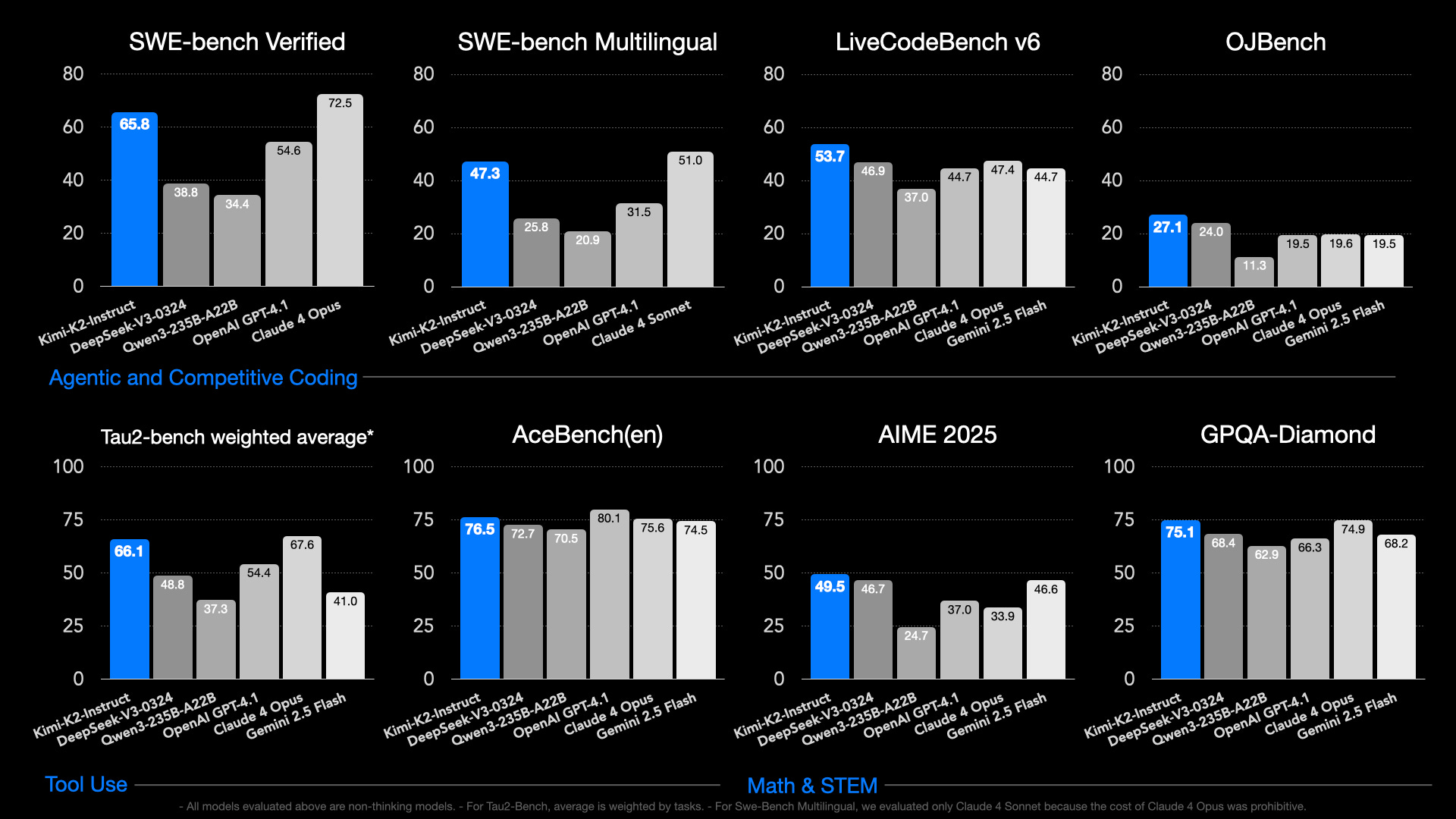
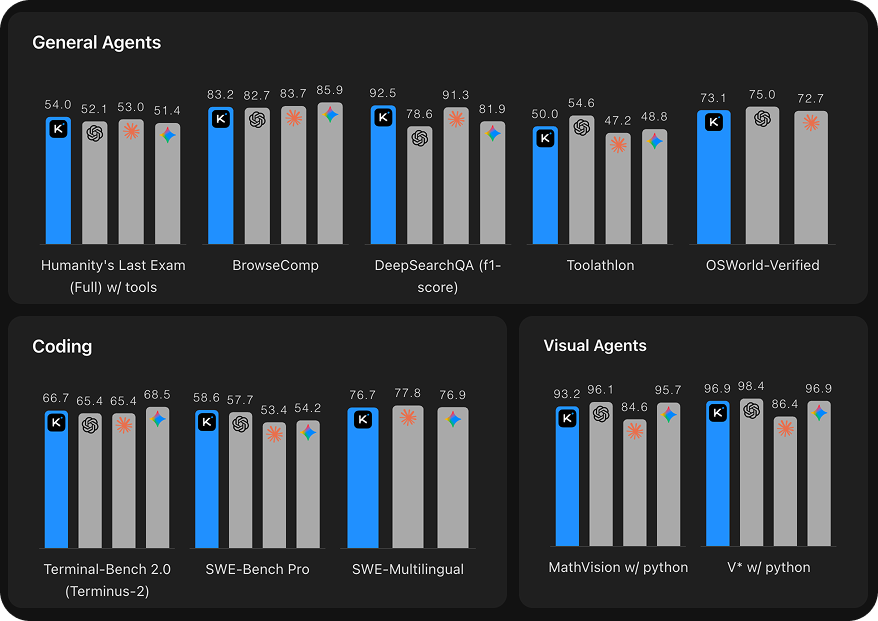
Put the stack together and the result is a model that competes on the dimensions that matter for real autonomous work. By Moonshot’s reported benchmarks, and as always, a vendor’s own numbers are a starting point, not a verdict, Kimi K2.5 scores in the mid-seventies on SWE-bench Verified, the standard test of resolving real software issues, and its thinking variant has posted state-of-the-art open-model results on the hardest agentic-search and reasoning benchmarks. Read these as claims to be tested, not facts to be repeated. What is not in dispute is the price attached to them: K2.5 runs at roughly a dollar’s fraction per million input tokens, on the order of four times cheaper than the comparable closed model from OpenAI and twenty-some times cheaper than Anthropic’s flagship, and the weights are released under a permissive MIT license.
That combination relocates the question of who gets to build. The barrier that frontier agency used to impose was never really hardware in a dorm room. It was budget in a boardroom: the capital to license a top-tier closed model at enterprise rates, or to train one of your own. When an open model reaches the agentic frontier and charges a small fraction of the closed rate, that specific barrier falls. A three-person startup can now build the kind of multi-step, tool-using, long-horizon agent system that two years ago required a frontier lab’s resources, and can do it on weights it owns rather than capability it rents under terms that can change. This is the real shape of the democratization, not that the model got small enough for anyone to run, but that frontier-grade autonomy got cheap enough for anyone to build on.
The adoption pattern bears this out, with one correction worth making against the common framing. Kimi’s K2 release in mid-2025 was the fastest-downloaded model on Hugging Face in the day after it launched, and by early 2026 the K2 family had become one of the most-downloaded open-weight model series there, a watershed that observers compared, fairly, to DeepSeek’s own breakthrough. It is among the most accessible state-of-the-art model families in existence. But “most accessible” is not the same as “runs on your laptop,” and the difference is the next section.

Part Four: What It Is Not
A piece that overstates this would say Kimi dropped the floor of serious AI work to nearly zero, that anyone can now run frontier capability on their own hardware. That is not true, and pretending otherwise would mistake the thing this model actually is.
Kimi is a one-trillion-parameter model. Even activating only thirty-two billion parameters per token, the full weights must still reside somewhere, and that somewhere is substantial GPU infrastructure, not a gaming machine, not a single consumer card. The practical consequence is that most teams use Kimi through its API or a cloud inference provider rather than self-hosting it, and its local-deployment ecosystem remains less developed than the one around the small models built to run on ordinary hardware. The weights are open, but openness of license is not the same as ease of local execution. The models that genuinely run on a student’s laptop are smaller things, the compact open models, the distilled variants, not a trillion-parameter agent.
So the democratization Kimi delivers is of access to capability, not local inference. You do not need a frontier lab’s budget to build with frontier-grade agency; you do still need real infrastructure, or a provider who has it, to run the model itself. That is a narrower claim than the slogan, and it is the true one. Stating it plainly is what lets the rest of the argument stand: the barrier that fell is the one that mattered most, and naming the barriers that did not fall is how you keep from selling a story the model cannot back.

The Layered Commons
Step back from Kimi specifically and a shape comes into view that none of these models reveals on its own.
Kimi took DeepSeek’s Multi-Head Latent Attention and built a trillion-parameter agent on top of it. To make that model trainable, it developed MuonClip, and published it, so the next lab need not solve instability from scratch. Its quantization recipe is open; its weights are open; its technical reports are open. GLM, in the previous piece, did the same thing in the other direction: it took DeepSeek’s sparse-attention design and optimized a layer above it. Each lab inherits the floor the last one poured and adds a course of its own, in public, where everyone can see it.
This is not how the closed frontier competes. There, each advance is a moat, held, not shared, because the advantage lies in keeping it. The open field runs on the opposite logic: an efficiency win published is an efficiency win that compounds, because it becomes the baseline everyone else starts from. It is the reason the gap to the frontier has closed as fast as it has, and the reason the strongest open model is a title that changes hands every few months while the field as a whole only ever moves up.
Which raises the question this series has been circling from the start. If every lab is building on the floor the others pour, if Kimi stands on DeepSeek’s attention and GLM stands on DeepSeek’s attention and the optimizers and the RL methods trace back through the same handful of published papers, then one lab has been quietly load-bearing for all of them. The final piece names it, and asks what it means to be the foundation that the whole open ecosystem rests on, and that no one owns. [forthcoming: The Foundation Nobody Owns.]

"Kimi's breakthrough wasn't that it could answer harder questions. It was that it could stay on task long enough to finish the work.

The series:


Sources
https://www.citadelsecurities.com/news-and-insights/global-market-intelligence/1h-2026-market-structure-flows/