

Africa Is Not Running Toward the Finish Line. It Is Redrawing It.
350 million people, one window, and the collective fear driving Africa's AI moment. Egypt and Nigeria are racing to ensure the next wave happens for them, not to them.


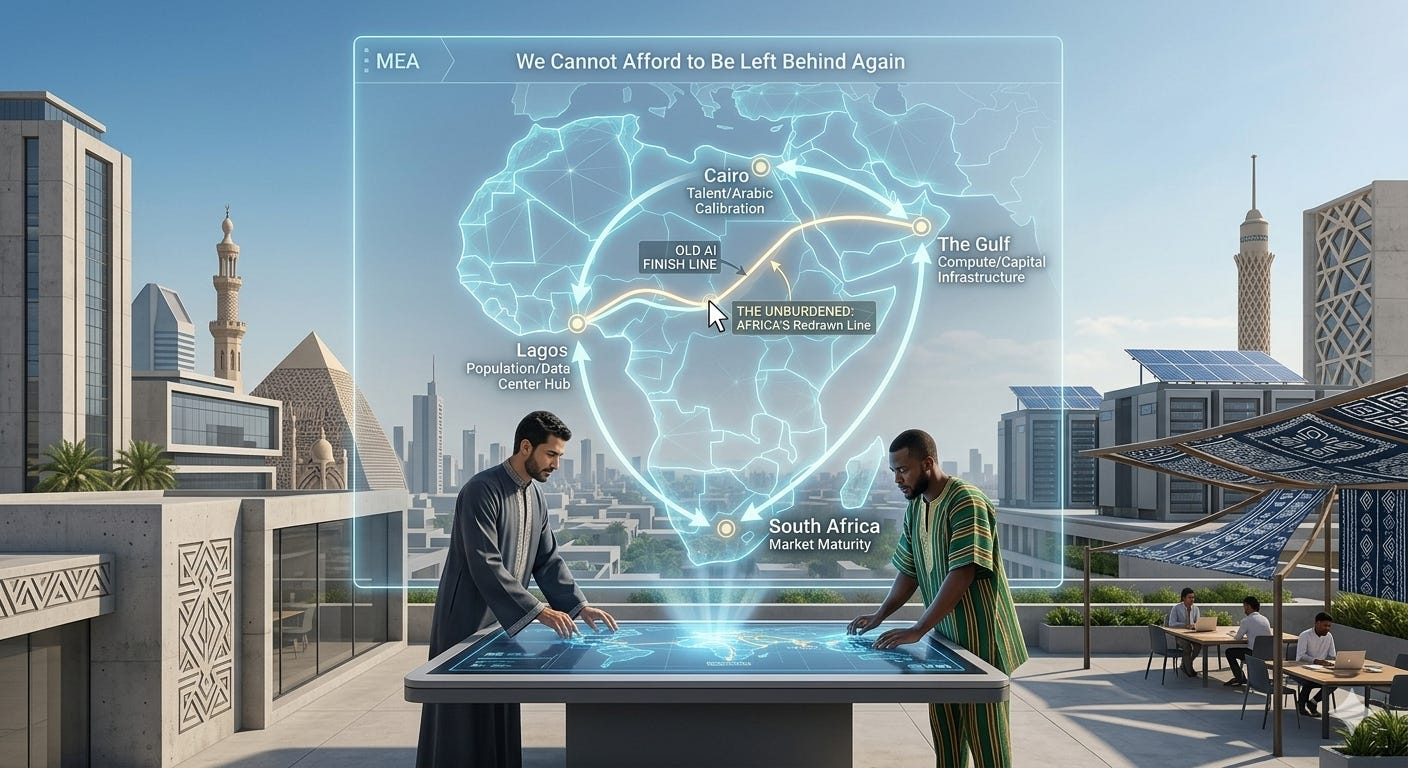
This article is a collaboration between Farida Khalaf and Tope Olofin. We wrote it together because the story of Africa’s AI moment cannot be told from one country alone. Egypt and Nigeria share the same fear, the same urgency, and the same window. We are each writing from inside it.
We Cannot Afford to Be Left Behind Again
There is a specific kind of fear that comes from watching a wave pass you by.
Not the fear of the unknown. The fear of the already-known, the memory of what it cost the last time. The internet happened to Africa before it happened for Africa. Mobile banking arrived late. The first wave of globalization left the countries that built the human infrastructure of the global economy, the call centers, the data entry hubs, the freelance pipelines holding the bill.
AI just automated that layer.
Not gradually. Not eventually. Now.
Egypt has 116 million people. Nigeria has 233 million. Together they represent nearly one third of Africa’s 1.4 billion, the two most populous nations on a continent that cannot afford another wave that happens to it rather than for it. The fear driving Africa’s AI race is not abstract. It is economic, specific, and correct.
A Different Battlefield
Western AI commentary makes a consistent error: Africa’s AI adoption is not a slower version of what is happening in the US or EU. It is a fundamentally different phenomenon.
The developed world is managing AI as disruption legacy infrastructure to migrate, incumbent industries defending market positions, regulatory frameworks built for a previous economy. The friction is the weight of what already exists.
Egypt and Nigeria are managing AI as construction on open ground. Neither country built the branch banking infrastructure that Germany spent decades establishing, they skipped it entirely, going straight to mobile-first financial services. Nigeria’s mobile banking penetration now sits at 82%, ranking among the highest globally not despite its underdevelopment but because of it. There was no incumbent infrastructure to defend, no legacy system to migrate, no industry lobbying to slow the transition. The same logic now applies to AI. No incumbent healthcare records system resisting AI diagnostics. No enterprise software debt to migrate. The absence of foundation is a genuine challenge. In a technology transition, it is also a structural advantage.
The global AI narrative assumes Africa has a talent shortage. It does not. It has a talent diaspora.
Egyptian and Nigerian engineers trained at MIT, LSE, Sciences Po, and Wharton, many on scholarships, many from families who understood that education abroad was the most reliable investment available, now hold technical fluency from developed-market AI training and contextual intelligence that Silicon Valley cannot replicate: they know what the tools get wrong when applied to Arabic morphology, Yoruba language patterns, Egyptian health behaviors, Lagos informal market dynamics.
That combination does not exist in Silicon Valley. It exists in Cairo and Lagos.
The impediments are real. Cultural institutions that move slower than the technology demands. Corruption that leaks capital before it reaches execution. These are not stereotypes, they are the daily operational reality of anyone building in these markets.
But FOMO has now reached the institutional level. For a window not forever, but for a window, the fear of being left behind has aligned government incentives with national ambition. Egypt and Nigeria are currently inside that window.
The Geopolitical Map Nobody Is Drawing
The Gulf states, Saudi Arabia, UAE, Kuwait, Qatar have built the infrastructure layer. Supercomputers, sovereign AI strategies, data centers funded at a scale Egypt and Nigeria cannot match.
But infrastructure without population is a data center in a small market.
The Gulf needs Arabic-language applications, Islamic finance AI, Gulf-market cultural calibration and builders who understand those contexts from the inside. That talent is not concentrated in the Gulf. It is concentrated in Cairo and Lagos.
South Africa sees the same gap from a different angle. With 63 million people and AI readiness in the global top 40, it has maturity without scale. Egypt and Nigeria together represent 350 million people reskilling for an AI economy, the largest talent and consumer market on the continent, currently in formation. South Africa’s Vodacom partnerships and PIC investment delegations are not altruism. They are market positioning before the demographic dividend fully activates.
Four players. One AI economy in formation. Nobody has everything. Everyone needs someone else.
Egypt: Renting Velocity
Egypt’s strategic choice is speed over sovereignty. AWS and Azure deployments through MCIT and Vodafone give Egyptian developers world-class compute without the capital expenditure of building it. The tradeoff is dependency. The calculation is that adoption speed matters more right now than ownership.
The results are visible. Nesma Amin’s Aziza AI health tracker, recognized at Aurora 2025 is the kind of application only an Egyptian builder can produce: Arabic-language capable, calibrated for health behaviors and access patterns that global health AI consistently misrepresents. Amira Abdelaziz’s work at the Central Bank and the Women in AI council means Egyptian women are shaping the regulatory frameworks that govern AI adoption, rather than receiving frameworks designed elsewhere.
Egypt’s Maaki initiative, one million women in tech, 30,000 AI specialists by 2030, is not a diversity program. It is a workforce strategy. Egyptian women are filling the gap the global AI ecosystem left open: what AI tools cannot do in Arabic, in Egyptian context, for Egyptian users.
Nigeria: Building Resilience
In Nigeria, the effects of artificial intelligence are already visible in the digital labor economy.
Over the past decade, many Nigerians entered the global workforce through freelance platforms like Upwork and Fiverr. Work like transcription, content writing, customer support, and data annotation connected thousands of Nigerians to international clients as companies spread routine digital tasks across borders. AI tools are now starting to automate many of those same tasks. Tools that generate text or handle customer responses are already reducing demand for some of the work freelancers used to do. For a country that entered the digital economy partly through outsourced services, this shift is being felt early.
At the same time, Nigeria’s digital infrastructure is quietly expanding. Lagos has become one of Africa’s busiest data center markets. Nigeria now hosts more than twenty operational data centers, and new facilities continue to appear as internet traffic across West Africa keeps growing. International providers and local telecom companies are increasing capacity to serve businesses in Nigeria and users across the region.
This response is not coming from a single national strategy. It is forming through a mix of private infrastructure investment, developer communities, and experimentation across the ecosystem.
All of this is happening in a difficult energy environment. Nigeria has large energy resources but an unstable electricity grid. Power outages remain common, and many technology facilities cannot rely on public electricity alone. Yet the infrastructure keeps expanding. Nigeria’s substantial natural gas reserves, estimated at more than 200 trillion cubic feet make off-grid captive power generation viable in ways most African markets cannot match. Data center operators run on gas and hybrid solar systems, powering their own infrastructure independently of the national grid. The expansion is not happening despite the energy challenge. It is working around it, through it, and increasingly beyond it.
Alongside this infrastructure growth, another pattern is clear. Nigeria keeps expanding its technical talent. This is partly a practical decision. Nigeria does not have the financial resources to compete with global AI leaders in building massive training clusters or foundational models. What it does have is people. Universities, nonprofit organizations, and government programs are training more engineers and data scientists every year. Initiatives like Data Science Nigeria have already trained thousands of young developers in machine learning and artificial intelligence.
This growing talent pool is shaping how AI is applied in the country. Instead of competing to build foundational models, many Nigerian developers are adapting existing AI tools to local realities. Many of these applications focus on practical problems in finance, healthcare, logistics, and language services. In this environment, innovation often comes less from building new platforms and more from making existing technologies work in places where infrastructure is uneven and markets are highly informal.
Nigeria’s experience reflects a broader challenge across much of the continent. Africa has already experienced several technological waves where adoption came late or unevenly. Artificial intelligence could widen that gap again. Nigeria’s response suggests one possible path: expand infrastructure where possible, invest heavily in technical talent, and adapt global technologies to local conditions as quickly as possible.
The Light Arrives Before the Shadow
Every honest account of AI must name what can go wrong.
Bias in systems trained on developed-market data is already documented in African contexts facial recognition that performs poorly on darker skin tones, medical AI uncalibrated for African disease profiles, credit scoring that penalizes informal economic behavior that is entirely rational in markets without formal credit infrastructure. Surveillance technology sold to governments with poor human rights records. Deepfakes in electoral contexts. Influence operations in fragile democracies with less institutional resistance.
The dark side exists. Guardrails matter.
And yet, in Africa, the light is arriving before the shadow.
The displacement narrative dominating global AI coverage is a white-collar story. Lawyers, analysts, knowledge workers in developed markets watching AI absorb the cognitive tasks that justified their salaries. That damage is real in New York and London and Frankfurt.
It has not landed with the same force in Cairo and Lagos because the majority of employment here is informal, contract-free, mano de obra. Physical, relational, contextual work that AI cannot yet replicate. The white collar layer that AI is currently displacing in developed markets is thin here. The labor market is not structured in a way that makes displacement the primary effect not yet.
This creates a specific and time-limited window. While the West manages AI disruption, Africa can adopt AI as a construction tool. Build with it before it displaces. Medical diagnostics reaching communities with no doctors. Financial services reaching the unbanked. Agricultural intelligence reaching smallholder farmers. Arabic and Yoruba language tools built by people who speak those languages for the populations global AI has historically ignored.
The damage is not yet seen in Africa. The opportunity is already arriving.
That window will not stay open indefinitely. The question is whether Egypt and Nigeria use it to build the application layer, develop the talent pipeline, and establish the regulatory frameworks that determine whether the next wave happens to Africa or for it.
The Collective Will
Egypt has carried a broken trust between its government and its people since independence. That fracture deepened after 2011 and has never fully healed. The distance between what citizens needed and what institutions delivered became the defining feature of public life. Not cynicism as attitude. Cynicism as rational response to accumulated evidence.
And yet something is shifting.
AI is not a political program. It cannot be co-opted by a faction or claimed by a revolution. It is infrastructure for human capability and both the Egyptian government and Egyptian citizens want it for the same reason and at the same time. The appetite is mutual. The FOMO is shared. For the first time in a long time, the direction of travel is the same on both sides of a divide that has defined Egyptian public life for decades.
That alignment is fragile. It is not a resolution of the underlying fracture. The corruption has not disappeared. The institutional friction has not dissolved. But in the specific arena of AI adoption of reskilling, of building, of not being left behind again, government and people are looking at the same horizon with the same urgency.
That is historically rare in Egypt. And it may be enough.
The Finish Line Is Being Redrawn
The countries that skipped legacy infrastructure are not behind. They are unburdened.
The fear of being left behind is real. The response to that fear, urgent, imperfect, women-led, cross-continental is producing something the countries driving the AI race from the front have not anticipated: a different kind of AI. Calibrated for contexts the training data ignored. Mobile-first because the desktop economy never fully arrived. Arabic-language capable and Yoruba-aware, designed for populations that global AI currently serves poorly or not at all.
The global AI race has a finish line. Africa is not running toward it.
Africa is redrawing it.
Sourcing: Nigeria data center figures from industry infrastructure reports, February 2026. Nigeria natural gas reserves from public geological surveys. Nigeria mobile banking penetration from global fintech adoption indices. Egypt initiative data from MCIT Egypt. AI automation projections from McKinsey Global Institute.
https://english.ahram.org.eg/NewsContent/1/2/550024/Egypt/Society/Egypt-launches-%E2%80%98Maaki%E2%80%99-initiative-to-train--millio.aspx
 | A guest post by
|